
Hai Phong Infrastructure Investment Speeding Up
Hai Phong has long benefited from its port location. The current wave of roads, bridges, airport works and rail investment is making that advantage more usable by improving route choice, easing pressure on key gateways and strengthening the wider industrial ecosystem.
On a recent drive through Hai Phong, one impression was difficult to miss. Major construction sites now appear across the city: new bridge structures rising over rivers, road embankments extending through the eastern districts, works continuing at Cat Bi Airport, and further investment around the deep-water port at Lach Huyen. Taken together, these projects show a city working to turn a strong location into a more complete industrial platform.

Image 1: The Tan Vu interchange immediately adjacent to Nam Trang Cat Industrial Park, providing seamless connectivity to the Hanoi–Hai Phong Expressway and Hai Phong’s key arterial road network to City Centre and Lach Huyen Deep Seaport.
For manufacturers, the relevant question is not how much concrete is being poured. It is whether the network will make factories easier to operate: more reliable truck journeys, more shipping options, better access for employees and specialists, and fewer points at which one local bottleneck can disrupt an entire supply chain.
The public investment signal
The scale of the commitment is meaningful. The expanded Hai Phong municipality assigned more than VND 36.7 trillion under its 2026 public investment plan. This follows a strong execution record in transport infrastructure. During 2021 to 2025, the city transport project management unit was allocated nearly VND 23.5 trillion across 63 projects, completed close to 40 projects and reported a cumulative disbursement rate of 99.99 percent.
That execution record matters because infrastructure announcements create value only when projects are completed and connected to the rest of the network. Hai Phong still faces the usual delivery risks, including land clearance, material supply, weather and skilled labour. Even so, the combination of funding and demonstrated delivery capacity gives investors a firmer basis for planning than a project list alone.
It is also important to use the term public infrastructure carefully. Not every asset is financed directly by the city budget. Port terminals and airport facilities may involve state-owned enterprises or private investors. The public role is still decisive because roads, bridges, navigation channels, land clearance and national rail links make those commercial investments work as one system.
Port capacity and the roads behind it
Lach Huyen shows how this works. Container berths 3 and 4 were inaugurated in May 2025 with capacity of about 1.5 million TEU per year, while berths 5 and 6 entered operation with capacity reported at up to 2.2 million TEU per year. With all six deep-water berths operating, larger vessels and more direct services can call at Hai Phong. By the end of the first quarter of 2026, port throughput had reached more than 28.3 million tonnes, up 6.4 percent from a year earlier, and the port area supported 30 maritime services connecting with Asia, Europe and the Americas.

Figure 1. 2025 actual volumes and 2026 official targets. Implied increases are calculated from the reported figures. Source: Bao Hai Phong, 26 April 2026.
Port capacity alone, however, does not guarantee smooth logistics. Trucks still need dependable access between the quay and the regional road system. Hai Phong therefore launched the road behind Lach Huyen berths 3 to 6, a 1.832-kilometre, six-lane project with investment of more than VND 716 billion. The project is short in distance but important in function: it addresses the last mile that determines whether new terminal capacity can be used efficiently.
This is a useful lesson for industrial site selection. The weakest connection often matters more than the headline distance to a port. A factory located near a deep-water terminal still carries logistics risk if its trucks must rely on a congested junction, a temporary road or a single river crossing.
Ring Road 2 and the eastern industrial corridor
Ring Road 2 is the most relevant current road project for Hai Phong's eastern industrial and port corridor. The section from Tan Vu through Hung Dao to Bui Vien is about 11 kilometres long and includes Hai Thanh Bridge across the Lach Tray River as well as a major interchange at Bui Vien.

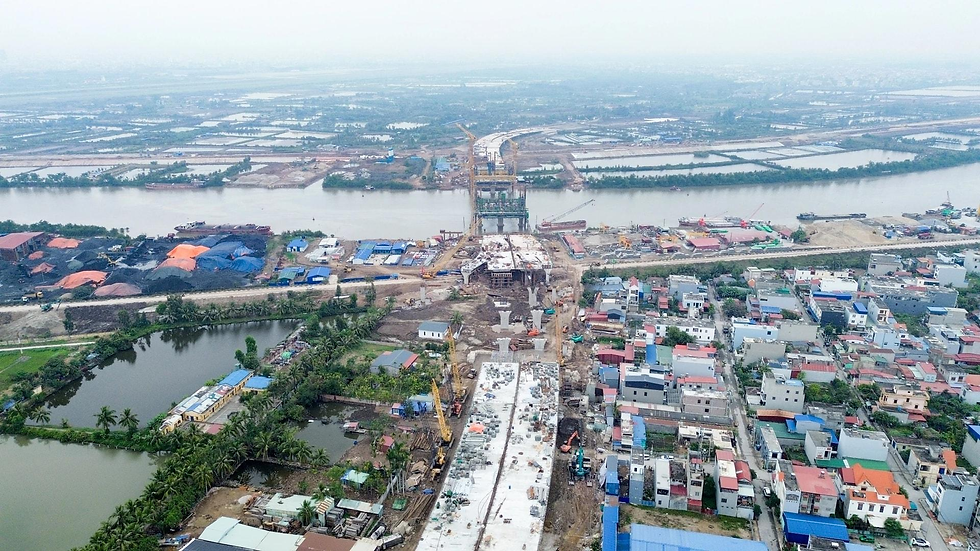
Images 2: Hai Thanh Bridge under construction near Nam Trang Cat Industrial Park, further strengthening connectivity to Hai Phong’s urban areas, ports and regional transport network.
According to an August 2026 site update, the project had reached about 61.5 percent of construction volume, with total investment reported at more than VND 8.593 trillion. The city is pressing contractors toward opening around the 30 April and 1 May 2027 holiday period.

Figure 2. Reported construction volume as of 26 August 2026. Source: Bao Hai Phong.
When completed, the corridor should provide a stronger route between the port area and National Highways 5 and 10, while reducing dependence on busy internal streets. For industrial locations in Hai An, including Nam Trang Cat, the benefit is practical: more route options and a better chance of consistent truck journeys during peak periods. Actual travel time will still depend on the final access arrangement, traffic management and the completion of connecting roads, so investors should avoid treating forecast journey times as guaranteed.
Other bridge investment is widening the regional catchment. Ben Rung Bridge opened in July 2024 to create another connection between Hai Phong and Quang Ninh. This link supports commuting, supplier access and regional movement, which are increasingly important as manufacturers recruit across a wider labour market.
A wider regional network
Road and port investment is being complemented by rail and aviation. The Lao Cai Hanoi Hai Phong railway is planned as a new standard-gauge corridor for both passengers and freight, linking the China border through Hanoi to Hai Phong. Early works and station-related construction were launched in late 2025, while the main line remains a medium-term project targeted for completion by 2030. Its industrial value would come from adding another freight option along the northern manufacturing belt and strengthening the connection between border trade and Lach Huyen. Investors should view it as future capacity rather than an operating benefit today.
At Cat Bi International Airport, the T2 passenger terminal is under construction with total investment of nearly VND 2.69 trillion and planned capacity of five million passengers per year. Completion is targeted for 2027. This will not replace sea freight or road freight, but it can improve access for management teams, engineers, customers and overseas specialists, a factor that matters for high-technology and export-oriented projects.
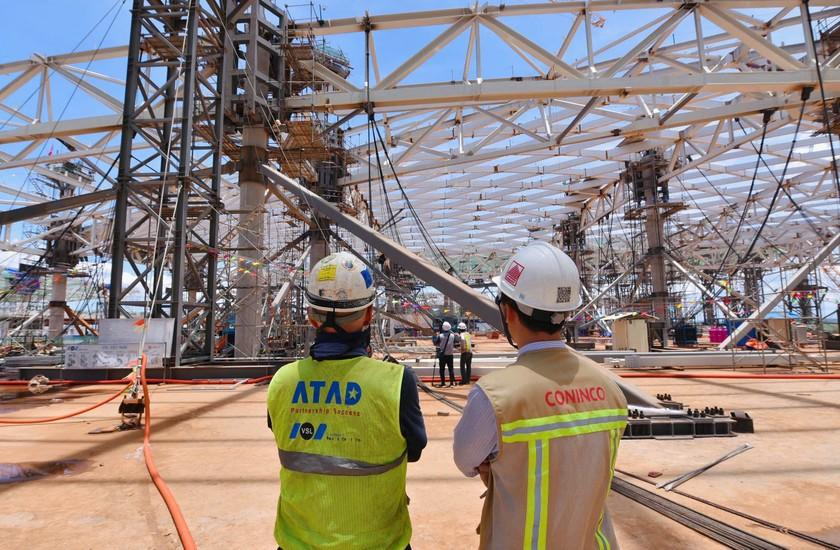
Images 3: Terminal 2 at Cat Bi International Airport under construction, expanding Hai Phong’s aviation capacity and strengthening connectivity for passengers, businesses and international investors.
What industrial investors should take from the build out
The first benefit is greater operating reliability. Additional bridges, bypasses and port access roads create alternatives when a route is congested or disrupted. The saving is not limited to kilometres. More dependable arrival times can reduce buffer inventory, missed vessel cut offs and uncertainty in production planning.
The second benefit is a wider industrial catchment. Better links connect factories with more suppliers, logistics providers, residential areas and labour pools. This can support recruitment and local sourcing as the city's industrial base grows.
The third benefit is follow-on investment. Public roads and common infrastructure make it easier for private capital to fund ports, warehouses, industrial parks, housing and business services. Lach Huyen demonstrates this clearly: public connectivity and planning have helped support successive rounds of terminal investment, which then create demand for further access improvements.
Finally, infrastructure changes the quality of Hai Phong's investment proposition. The city is moving from a location defined mainly by proximity to a port toward a connected production and logistics platform serving Northern Vietnam. That makes Hai Phong relevant to a broader group of manufacturers, including electronics, precision engineering, automotive supply chains, advanced materials and data-related industries.
A balanced view on timing
The investment case is improving, but each project should be placed in the correct time category. Existing expressways, the Tan Vu Lach Huyen crossing, six operating deep-water berths and Ben Rung Bridge are available today. Ring Road 2, Hai Thanh Bridge and Cat Bi T2 remain under construction. The new railway and further port expansion are medium-term developments.

Figure 3. Selected milestones. The 2027 and 2030 dates are delivery targets and should be refreshed before publication. Sources: Bao Hai Phong, Government News and Reuters.
A sound site decision should therefore work under current conditions and gain additional value as new infrastructure opens. Investors should test today's truck routes at peak periods, confirm utility capacity and delivery schedules, review land and construction readiness, and then model the upside from projects that are still being built. This approach captures the opportunity without relying on optimistic completion assumptions.
The NTC perspective
Nam Trang Cat Industrial Park is being developed in Hai An, within the Dinh Vu Cat Hai Economic Zone and close to Hai Phong's eastern port-linked corridor. The progress of Ring Road 2 and the wider transport network is therefore directly relevant to Nam Trang Cat and to the manufacturers considering this part of the city.

Figure 4. Key infrastructure projects currently under development around Nam Trang Cat Industrial Park, expected to further strengthen local and regional connectivity.
Our role is to translate the city's infrastructure advantage into a practical industrial location with clear access information, reliable utilities, legal readiness and responsive investor support. We will continue to monitor the major projects around Hai Phong and share updates on what has opened, what remains under construction and what each change means for industrial operations.
To discuss industrial investment opportunities at Nam Trang Cat Industrial Park, please contact the NTC team.